
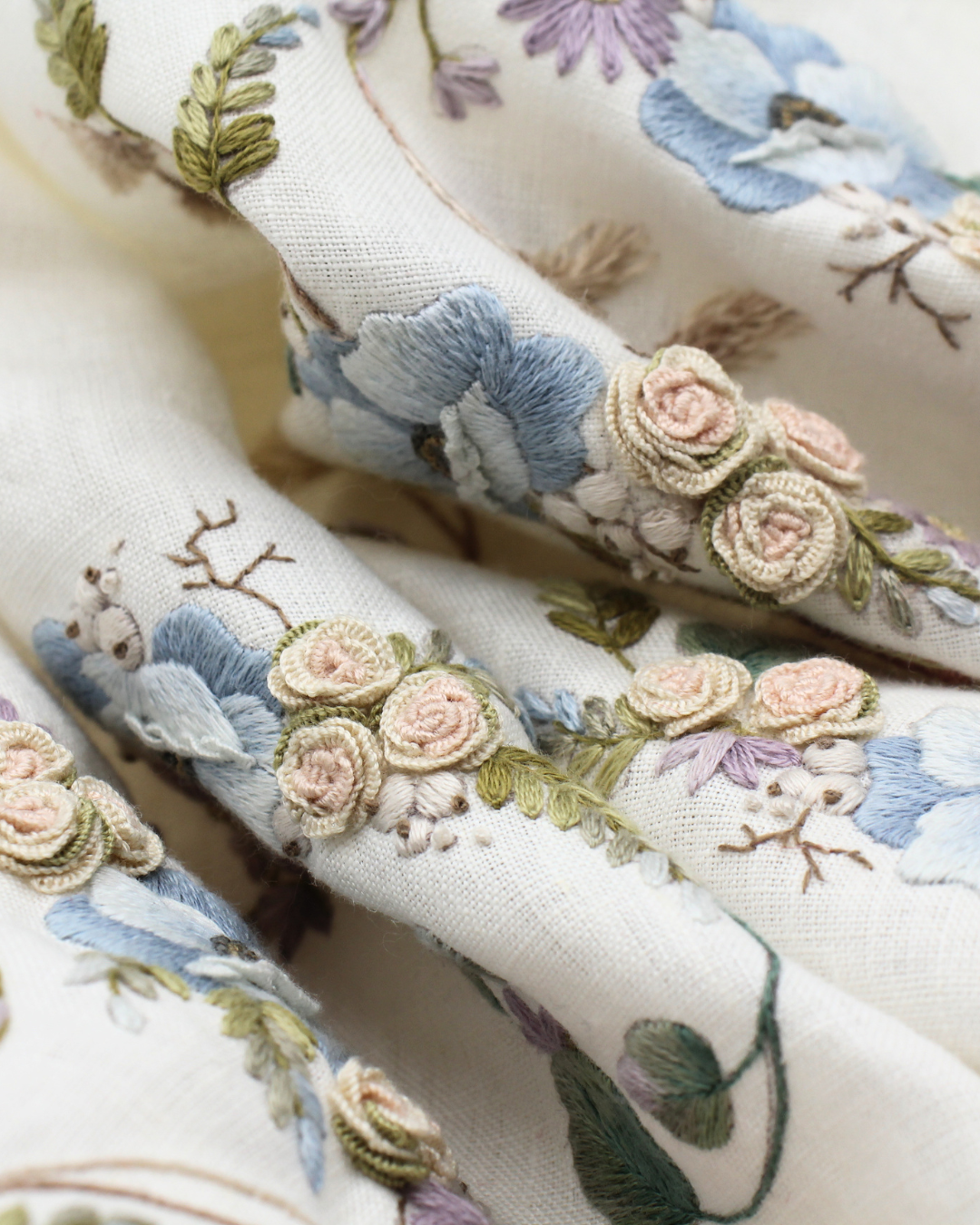
Beyond the symbolic or aesthetic design of the piece, whilst assembling the bouquet, I came up against major technical problems, which have become more complicated over the years, ever since I began to think of my embroidery as something that could be reproduced. That is to say… I always have in mind those who, after me, will want to copy and make my experience their own, and here, in particular, I was concerned about the difficulty of the stitches that were originally intended to be merely hinted at (long and short stitch and padded stitch) and are now almost predominant. But I also thought that, if we always and only propose patterns with stitches accessible to everyone, we risk not evolving, and that perhaps the challenge is actually to make slightly more complicated stitches accessible to everyone. To simplify things considerably, I chose to standardise the embroidery of the repetitive elements using the long and short stitch: essentially, all the anemones, anthuriums and groups of eucalyptus leaves are identical. In other words, I devised a little rule to follow, so that there is no coloured pattern to copy, but rather a sequence of colours to use. The aim is to dispel the notion that you need a ‘feel for colour’ (a widespread myth that needs debunking) to embroider these elements using long ans short stitch.
The other major technical challenge was that I wanted to introduce a three-dimensional quality to the composition, so I couldn’t limit myself to the flatness of the long and short stitch: this is how the padded stitch berries and the roses in bullion stitch and cast-onsatin stitch came about, the former with a gentle relief like a hill, the latter like jagged rocky outcrops. Not insignificant, though less obvious, are the differences between using a two-strand stitch instead of a single one and the introduction of small knots. To get there, I had to undo everything several times: either experience is never enough, or I simply don’t have enough experience.


Leave A Comment